woensdag 30 augustus 2023

American photographer, New York. Saved photographes

 Fotografen Berenice Abbott en Bill Wood: Parijs, New York en Texas | Kunst en design | De Voogd (theguardian.com)

De geschiedenis van de fotografie is bezaaid met bergingsverhalen - van de ene fotograaf die het archief van de andere redt en bewaart. Waarschijnlijk de grootste hiervan is het verhaal van Berenice Abbott, een jonge Amerikaanse portretfotograaf die in de jaren 1920 in Parijs woonde, een ex-student, zoals Lee Miller, van Man Ray. In 1925 raakte ze bevriend met een oude Franse straatfotograaf, die een buurman van Ray was in Montparnasse, en uiteindelijk vroeg ze of ze zijn portret mocht maken. Hij stemde toe. Ze nam de foto's, drukte ze af - één vooraanzicht, één zijaanzicht - en nam ze om hem de resultaten te laten zien. Maar in die korte tijd, ontdekte ze, was hij overleden. Zijn archief was nagelaten aan een vriend, André Calmettes, die vrijwel onmiddellijk 2.000 afdrukken verkocht. Abbott besloot de rest te kopen. In de herfst van 1928 nam ze 1.500 glasplaatnegatieven en ongeveer 8.000 prenten in ontvangst, en het jaar daarop, toen ze terugkeerde naar New York, nam ze het archief mee. Veertig jaar later werd het gekocht door het Museum voor Moderne Kunst en zo werd het werk van Eugène Atget, een van de grootste van alle fotografen, gered.

he history of photography is littered with salvage stories - of one photographer rescuing and preserving the archive of another. Probably the greatest of these is the story of Berenice Abbott, a young American portrait photographer living in Paris during the 1920s, an ex-student, like Lee Miller, of Man Ray. In 1925 she became friendly with an old French street photographer, who was a neighbour of Ray's in Montparnasse, and finally she asked if she could take his portrait. He agreed. She took the pictures, printed them - one front view, one side view - and took them to show him the results. But in that short time, she discovered, he had died. His archive had been left to a friend, André Calmettes, who sold off 2,000 prints almost immediately. Abbott decided to buy the rest. In the autumn of 1928 she took receipt of 1,500 glass-plate negatives and around 8,000 prints, and the following year, when she returned to New York, she took the archive with her. Forty years later it was bought by the Museum of Modern Art and thus the work of Eugène Atget, one of the greatest of all photographers, was saved.

maandag 13 maart 2023

Charles Marville, photographer of old Paris.


Beginning in 1852 and continuing for more than two decades, the French emperor Napoleon III, along with his apparatchik—Baron Haussmann, the Prefect of the Seine—embarked on a massive public works program to regularize and sanitize the medieval agglomeration that was Paris. The best-known aspect of this program was the circulatory network of new, straight boulevards that was surgically inserted into the fabric of the old city. Not for nothing was Haussmann dubbed the “Attila of the straight line” by a contemporary critic.  Commissioned in 1862 as the official photographer of Paris, Charles Marville—the subject of a traveling retrospective making its final stop at the Museum of Fine Arts, Houston—had a front-row seat to Napoleon III’s profound transformation of the city.


zondag 12 maart 2023

Cafe de Flore.

The first post-war surrealists

It was only in the last moments of World War I that Cafe de Flore began to attract artists. Guillaume Apollinaire, in 1917 was the first to install himself next to the heater in the morning and spend the day there. In addition to writing his books, he also brought his friends: André Breton, Paul Réverdy, Louis Aragon and Paul Éluard. While Montparnasse and Montmartre were still the favorite places for artists living in Paris, it is said that it was there at Café de Flore that the “surrealist revolution” began.

The Occupation and Golden Age of Café de Flore


Jean-Paul Sartre, Simone du Beauvoir and Boris Vian and his wife Michelle at Café de Flore

e.


Pablo Picasso at the Café de Flore. Photo by Brassai.

The surrealists ended up deserting in the following years and by the end of the 1930s, in an environment that nobody expected, Cafe de Flore found its new life. Parisian writers and artists have always frequented cafés, not for social life, but mainly to find a more pleasant and warm place than their tiny apartments. 

Installing a larger and more powerful coal-fired heater

It was in 1939 that the new manager of the Café de Flore had the brilliant idea of installing a larger and more powerful coal-fired heater to heat the establishment. This heater not only warmed up the ground floor, but also the first floor, which is much quieter. 

Simone de Beauvoir, who used to go to Dôme in Montparnasse, quickly got used to sitting at one of the dozens of tables on the first floor to work there. The director let her and some other regular customers go all day without consuming too much. 

Because they were less famous at that point, the cafés in Saint-Germain-des-Prés attracted fewer German Wehrmacht officers than the cafés in Montparnasse, so that the writers and thinkers of the time could work there with some peace of mind. On the recommendation of his wife Simone de Beauvoir, Jean-Paul Sartre arrived at Café de Flore in 1941. He came from a few months spent in the French army and in a detention camp in Germany.

Café de Flore - The most mythical of Paris' coffee shops | Gastronomos

The Lost Generation; Cafes in Paris | Lindsay (lindsaymagazine.co)


zaterdag 11 maart 2023

Reading "Chansons".


I am busy reading CHANSONS
And I am walking through Paris through You Tube and Google Earth

PLACE DAUPHINE


La Place Dauphine Appartementen In Het Centrum van Parijs | Parijs Perfect (parisperfect.com)

CHANSON

52. Il est cinq heures, Paris s'éveille (1968) - Jacques Dutronc | Chanson Klassiekers

FONTAINE MOLIERE


RUE RICHELIEU


LOUVRE


  • The First arrondissement is home to one of the most famous monuments in Paris: the Louvre. Mainly located on the Right bank of River Seine, it includes the Tuileries Garden, several historic churches and palaces, upscale squares and the bustling shopping precinct of Les Halles.
  • The district of Saint-Germain-l’Auxerrois is that of the Louvre and the Tuileries. Here, the arts flourish thanks to the presence of several renowned museums, including the Louvre and the Orangerie. It is a district where justice reigned in the Middle Ages and up to our time. Indeed, the Palais de Justice encircles the fabulous Sainte-Chapelle on the Ile de la Cité.
  • The district of Les Halles is animated by leisure and commerce. At the foot of Saint-Eustache, the Halles garden covers the Forum des Halles, a vast shopping mall buried on several levels. The garden faces the Bourse du Commerce.
  • The district of the Palais-Royal is rich in contrast. It concentrates on activities related to tourism, culture and literature. The Avenue de l’Opéra is lined with travel agencies and hotels. The Comédie française, theatres and the Ministry of Culture frame the gardens of the Palais-Royal. The memory of writers and artists floats in the maze of neighbouring streets.
  • The luxury industry and French savoir-vivre characterise the Vendôme district. Jewellers occupy the Place Vendôme and antique dealers line the Rue Saint-Honoré. On the neo-classical square of Place Vendôme, around the Ritz, haute couture and leather goods present the jewels of French design.
BOOKSHOPS
In addition, it boasts a few bookshops, including Librairie Delamain (the oldest bookshop in Paris at number 155 rue Saint-Honoré), Librairie Galignani and the British bookshop WH Smith (Rue de Rivoli). Lastly, you will find the FNAC (one of France’s premier bookshops) in the Westfield Forum des Halles.


De oudste boekhandel van Parijs en La Civette, waar George Sand haar sigaretten kocht

vrijdag 10 maart 2023

Iconic bookstores.

                                                          Three Lives & Co | Facebook

Three Lives & Company - Home

One of the greatest bookstores on the face of the Earth. Every single person who works there is incredibly knowledgeable and well read and full of soul. You can walk in and ask anybody, really, what they've read lately and they'll tell you something - very likely something you've never heard of. [But] it's always going to be something interesting and fabulous. I go there when I'm feeling depressed and discouraged, and I always feel rejuvenated.

- Michael Cunningham,
winner of the 1999
Pulitzer Prize for Fiction


Derek Addyman and Anne Brichto first opened Addyman Books in 1987, in a ten-foot room at the Blue Boar Inn in Hay on Wye. Only six months later success shunted us into larger premises on nearby Lion Street. This rapidly expanded into the well-loved burrow of books that is still to be found there today.

In 1997 we opened a bookshop specialising in detective fiction, Murder and Mayhem, just across the road. And five years later, the jewel in the crown of the Addyman triumvirate was opened – The Addyman Annexe. This is the shop that specialises in the sexier material: beat, sex, drugs, art, modern firsts, poetry, philosophy, left wing history and the occasional occult work!

Between the three shops an inviting little community has been created for the new visitor to hay as well as our regular customers. As with so many bookshops, much of our business is now conducted on the internet; but the development of e-commerce has been parallel to and not at the expense of our shops.

Addyman Books is known for its fair prices, clean and well chosen stock, and a specialization in English literature and modern first editions. The unusual combination of semi-suicidal owners and our lovely members of staff (Paula, our manager, Molly, Simon, Debbie, Ruth, Emma,  Juliet and Christina) makes this one of the most successful and exciting bookshops in Hay.


5 Bookstores Every Bibliophile Should Visit In Paris - Paris Perfect


woensdag 16 maart 2022

Patchin Place, New York City.


In het begin van de 20e eeuw werd Patchin Place populair bij schrijvers en kunstenaars, met zijn kleine woningen, die los stonden van maar nog steeds toegankelijk waren voor het caféleven van het dorp. Sanitair binnenshuis, elektriciteit en stoomwarmte werden in 1917 toegevoegd.
[8] In 1920 verkocht Grace I. Patchin Stuart, het laatst overgebleven lid van de Patchin-familie, het pand aan de Land Map Realty Corporation en de huizen werden omgebouwd tot kleine appartementen. [9] E. E. Cummings verhuisde drie jaar later; hij schreef dat "de bovenste verdieping achterkamer op 4 Patchin Place ... betekende Veiligheid & Vrede & de waarheid van dromen & de gelukzaligheid van werk".

De modernistische schrijfster Djuna Barnes had in de jaren 1910 in Greenwich Village gewoond, maar had het grootste deel van de jaren 1920 en 30 in Europa doorgebracht. Ze verhuisde in 1941 naar een appartement van anderhalve kamer op # 5 Patchin Place. Toen een ontwikkelaar in 1963 voorstelde om de huizen op Patchin en het nabijgelegen Milligan Place af te breken om een hoog flatgebouw neer te zetten, verliet ze haar appartement om een protestbijeenkomst te vertellen dat ze zou sterven als ze moest verhuizen. Gemeenschapsactivisten, onder leiding van de toekomstige burgemeester Ed Koch, slaagden erin Patchin Place te redden, en in 1969 werd het een mijlpaal[8] met de oprichting van het Greenwich Village Historic District.

Patchin Place blijft fysiek vrijwel onveranderd. Het heeft nogzijn 19e-eeuwse gasstraatlantaarn - een van de slechts twee in New York City, en de enige die nog steeds licht geeft, hoewel het licht nu elektrisch is. Het gebruik is echter veranderd: dezelfde privacy die ooit schrijvers en kunstenaars had aangetrokken, sprak ook psychotherapeuten aan, die zich daar in de jaren 1990 begonnen te vestigen en de straat transformeerden in wat een psycholoog "therapierij" noemde. Vanaf 2003 was Patchin Place de thuisbasis van ongeveer 35 bewoners en 15 therapeutenpraktijken.

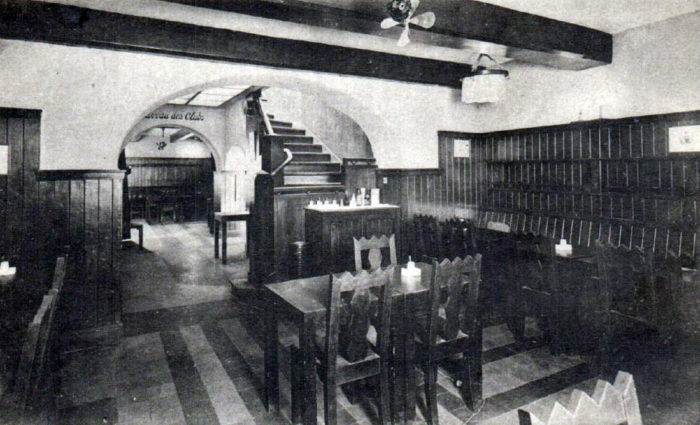
Taverne Charley.

O p Boulevard Garibaldi nr. 20 stond de Taverne Charley, die in 1933 werd geopend en nu is verdwenen. Simone de Beauvoir vestigde zich er gr...