donderdag 11 maart 2021

Paris between the Wars.


Between the Wars, Paris was home to the major French publishing houses and literary journals, and of France's most important writers.
 Marcel Proust was living at 102 Boulevard Haussmann, editing his most important work, In Search of Lost Time, which he had begun in 1909 but was not finished by the time of his death in 1922. It was finally published in 1929. Anatole France won the Nobel Prize for Literature for his novels and poetry in 1921; the philosopher Henri Bergson, won the Nobel Prize in 1927. Paris was the home of Colette, who lived in an apartment in the Palais Royal; of novelist André Gide, and of the playwright-author-filmmaker Jean Cocteau.

It was also home to a large community of expatriate writers from around the world. Ernest Hemingway, hired as a foreign correspondent for the Toronto Star, moved to Paris with his first wife Hadley in 1922 and made his first residence in a small upstairs apartment at 74 rue du Cardinal Lemoine. He remained until 1928, when he left with his second wife, Pauline. While there he wrote and published his first novel, The Sun Also Rises. Others in the literary expatriate community included the poet Ezra Pound, the writer and art patron Gertrude Stein, and the English poet, critic novelist and editor Ford Madox Ford.

In 1920, the Irish author James Joyce received an invitation from the poet Ezra Pound to spend a week with him in Paris. He ended up remaining for twenty years, writing two of his major works, Ulysses and Finnegans Wake. After the war began, in late 1940, he moved to Zurich, where he died. The Russian émigré Vladimir Nabokov lived in Paris from 1937 until 1940, when he left for the United States. Eric Arthur Blair, better known under his pen name George Orwell, lived in 1928 and 1929 on the rue du Pot de Fer in the fifth arrondissement, where he worked as a dishwasher in a Paris restaurant, an experience he immortalized in Down and Out in Paris and London.

An important meeting point for expatriate writers was the bookstore Shakespeare and Company (not to be confused with the modern bookstore of that name near Place Saint-Michel), first located at 8 rue Dupuytren from 1919 to 1922, and then from 1922 to 1940 at 12 rue de l'Odeon. It was run by the American Sylvia Beach. Hemingway first met Ezra Pound here, and Beach published Jame's Joyce's Ulysses, which was banned in Britain and the United States.

Pablo Picasso was perhaps the most famous artist in Paris, but he shared the spotlight with a remarkable group of others, including the Romanian sculptor Constantin Brâncuși, the Belgian René Magritte, the Italian Amedeo Modigliani, the Russian émigré Marc Chagall, the Catalan and Spanish artists Salvador DaliJoan MiróJuan Gris, and the German surrealist and Dadaist Max Ernst. Several major artistic movements flourished in Paris at this time, including CubismSurrealism, and Art Deco. The American art patron Gertrude Stein, resident in Paris, played an important role in encouraging and buying works of Picasso and other artists of the period.

Crystal Cubism was featured in major exhibitions at Léonce Rosenberg's Galerie de L'Effort Moderne.[43] Rosenberg became the official dealer of the Cubists, purchasing works, in addition to those he already owned, by artist such as Jean MetzingerAlbert GleizesFernand LégerJoseph CsakyHenry LaurensGeorges Valmier and Henri Hayden.[44] Picasso eventually switched to his brother Paul Rosenberg's gallery, who would become his dealer Entre Deux Guerres.[44]

theculturetrip/paris/gay-paris-20th-century-lesbian-culture-in-the-city-of-love/


zondag 2 augustus 2020

Houses of Simone de Beauvoir.

Simone de Beauvoir was born above the Café de la Rotonde in Paris in 1908


Royal-Bretagne


The writer Simone de Beauvoir spent the academic year of 1936-1937 based at the hotel then named Royal-Bretagne living there with Sartre when he was in Paris at No. 11bis. Today, this art-deco hotel has another name and looks more upmarket than it did in the 1930s.

Nearly opposite De Beauvoir’s hotel was the famous Bobino music hall at No. 20, sadly demolished in 1985 and turned into a Mercure hotel with a new Bobino now at the back. De Beauvoir and Sartre saw two singers there in 1932, singing anarchist and anti-militarist songs.


Le Dôme  

Location: 108 Boulevard du Montparnasse, 75014 Paris. 

Simone de Beauvoir en  Jean-Paul Sartre maakten het tot hun hoofdkwartier. Ze gebruikte er het ontbijt, werkte in een box  achterin het café. Vreemdelingen uit allerlei landen discussieerden er met elkaar. Modellen, vrouwelijke artiesten, meisjes die door de een of ander werden onderhouden. Er ontstond een soort zwijgende band tussen ons en de andere stamgasten. De bloei van het Leven blz. 280.


 Mistral Hotel
24 Cels Street

1937 tot september 1939


Simone huurt hier een kamer (en Sartre een andere) 
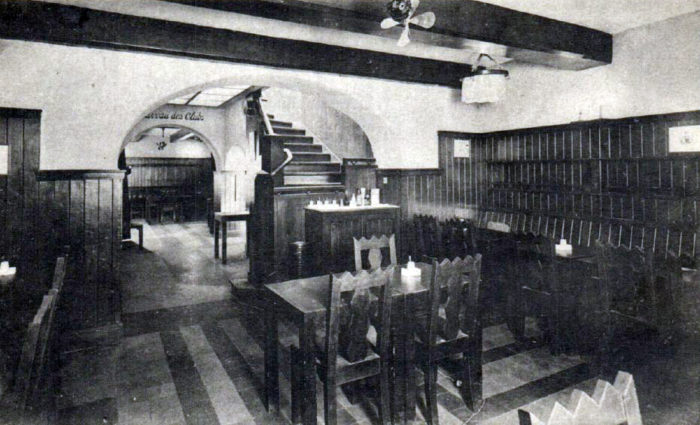
 Ze geniet van een ontbijt in de Three Musketeers Brewery, 77 Maine Avenue
 Ze wil schrijver worden en werkt aan haar eerste roman, De gast

Hotel du Denmark
 Rue Vavin 21
Oktober 1939


21 Vavin Street, Simone de Beauvoir in het Denmark Hotel

 -In juni 1940 verliet ze de hoofdstad omdat de Duitsers Parijs binnen vielen

 28e  juni keerde ze terug
Haar spullen waren weggegeven
Zij ging kort wonen in het appartement van haar oma 
 Weer terug in Hotel Danemark tijdens de strenge winter van 1940-41. 

En octobre 1939, la voilà à l’hôtel du Danemark, 21 rue Vavin. En juin 1940, elle quitte la capitale, puis la regagne le 28 lorsqu’il apparaît que l’on peut y habiter en relative sécurité. Elle retrouve alors le studio de sa grand-mère et passe ses après-midis d’été à lire Hegel à la Bibliothèque nationale, rue de Richelieu. - Elle regagne la chaleur d’une chambre à l’hôtel du Danemark pendant le très rigoureux hiver 1940-41. Elle donne à nouveau des cours au lycée Camille-Sée, 11 rue Léon-Lhermitte. terresdecrivains/Simone-de-BEAUVOIR-a-Paris

Mijn kamer bevalt me best. Er hangen heel dikke rode gordijnen en ik kan er 's avonds het licht aan doen. Uit: De Bloei van het Leven, blz. 409.

 HOTEL MISTRAL

After being released from his prisoner-of-war status in 1940, Sartre returned to the Hotel Mistral, where de Beauvoir also moved back to. In 1941 the first meeting of the intellectual resistance group, ‘Socialism and Freedom’ (Socialisme et Liberté), was held in Simone de Beauvoir’s room.


In 1942 Simone de Beauvoir was staying at the Hôtel d’Aubusson, also at No. 33, when she was forced out of teaching. The left/existentialist intellectual bar, Le Tabou, that had been the Bar vert in the Rue Jacob was reopened in the basement by Juliette Greco for rehearsals in 1946 before opening to the public the following year.

Outside No. 7 there is a plaque on the wall. This is where in 1937 Picasso painted Guernica in his roof-top studio for the Spanish Republic’s hall in that year’s Paris International Exhibition. In vain Picasso left a will stating that the work would only be returned to Spain when it was again a Republic. leftinparis/de-beauvoir

Hotel Louisiana


Robert Doisneau, Paris, 1950 / St Germain des Prés - Hotel La Louisiane (Rue de Seine)

Hotel La Lousiane is a hotel on Rue de Seine in Paris, France. Constructed in 1823 by a former 
officer in Napoleon’s army, the hotel later became a home base to jazz musicians and writers
beginning in the 1920s. Ernest Hemingway, Antoine de Saint Exupery, Jean-Paul Sartre (room 10), 
Simone de Beauvoir (room 68), Henri Miller and many more.

"I'd never lodged anywhere that fulfilled my dreams as that place did; I would have happily stayed
 there for the rest of my life. At the other end of the corridor, Sartre had a tiny room where he lived
 in a state of asceticism that never ceased to shock his visitors: he didn't even have any books."

In the spring of '44, when the Allies landed in Normandy, some of the hotel guests used to go
 and sunbathe on the roof terrace. "I couldn't bear the hot sun beating down on the hard cement, "
 wrote Beauvoir, "but in the evenings, I liked to go up there and sit and read or chat. "


Simone de Beauvoir, Hôtel La Louisiane, Paris, 1946
More interesting facts on cocosse-journal

Rue Bonaparte Nr 42

 
Sartre 4-e verdieping
from 1945 to 1962


11 Rue de la Bucherie
LATE OCTOBER 1948: de Beauvoir moves to 11 rue de la Bucherie

Simone de Beauvoir lived at  from 1948- 1955
Writing some of her most inportant works
The Second Sex
The Mandarins
Memoirs of a Dutiful Daughter
Force of Circumstance

Nelson Algren's residence in Chicago


Algren lived on West Wabansia Avenue in a building demolished to build the Kennedy Expressway, and then from 1959 to 1975 at this Evergreen Avenue property. There he occupied the third floor of the brick three-flat. literary-landmarksThe expressways tore into the neighborhoods, knocking down the building on Wabansia where he spent his most productive years. 

When Simone de Beauvoir first visited Chicago in 1947, she called on author Nelson Algren, who lived just down the street from St. Stan’s at 1532 West Wabansia. Her impression of his home:
He lived in a hovel, without a bathroom or a refrigerator, alongside an alley full of steaming trash cans and flapping newspapers; this poverty seemed refreshing, after the heavy odour of the dollars in the big hotels and the elegant restaurants, which I found hard to take. rostenkowski-curve 
 nelson-algrens-last-residence

1958 W. Evergreen Ave.
Chicago, Illinois, 60622
United States
https://vimeo.com/ondemand/nelsonalgren

Nelson Algren’s Indiana getaway


Nelson Algren bought his beach cottage in Miller, Indiana in 1950, partially from the proceeds from the film rights to “The Man with a Golden Arm. Algren and Simone de Beauvoir drank, swam, hiked, made love, wrote and enjoyed the dunes area just east of Gary only forty-five minutes from downtown Chicago.


The studio of Simone de Beauvoir,
Rue Schoelcher 12 bis, Montparnasse, Paris


Simone de Beauvoir in her studio, rue Schoelcher 12 bis, Montparnasse, Paris, March 1986.
Bettina Flitner/National Museum of Women in the Arts

zondag 5 juli 2020

Meredith´s Grey house.


Hoping to see Meredith Grey, Izzie Stevens or Arizona Robbins pop out of the intern house on their way to work? panpacificseattle/greys-anatomy-guide-seattle

Years later, Ellis wound up in Roseridge Home for Extended Care because of her Alzheimer's disease, so Meredith applied for an internship in Seattle. She temporarily moved back into the house and started to pack up her mother's old stuff since she planned to sell the house. After a one night stand and her first days at Seattle Grace Hospital, Meredith decided she'd stay in the house and got Ellis to sign over the estate. Meredith put up a notice for roommates and chose Izzie Stevens and George O'Malleygreysanatomy


maandag 22 juni 2020

Hotel Danieli, George Sand, stayed with her lover Alfred de Musset.

Jump to search

Hotel Danieli

View from Saint Mark's Basin
Hotel Danieli, formerly Palazzo Dandolo, is a five-star palatial hotel in Venice, Italy. It was here that Aurore Dudevant, better known as George Sand, stayed with her lover Alfred de Mussetwiki/Hotel_Danieli


Taverne Charley.

O p Boulevard Garibaldi nr. 20 stond de Taverne Charley, die in 1933 werd geopend en nu is verdwenen. Simone de Beauvoir vestigde zich er gr...